
[What is a “semi pro rider?”]
Further to yesterday’s post, most cyclists espouse a preference for one frame material or another. Certainly there are those of us who embrace a variety of materials for a variety of uses. Then there are those who will fight practically to the death in defense of their favorite:
Sometimes we form our opinions based on our own experiences. Other times we base it on factors as disparate as aesthetics, the opinions of others we admire or trust, intensive research, and anecdotes we read on the Internet. As for me, I’ve come to prefer steel over all else and think it’s the best choice for a bike frame in most applications. But do my actual experiences bear that out? Or is it just that I like the idea of the stuff and what it represents: traditional design, dependability, relative affordability, yadda yadda yadda?
Now, I should once again acknowledge, as I did yesterday, that what kills most bikes (assuming they’re properly designed and built) isn’t the inherent flaws in whatever material it happens to be made from; rather, it’s the rider’s own boredom and desire for something new. Also, it’s important to remember that people who write about bikes–even washed-up semi-professional bike bloggers–have easier access to bicycles than most “normal” people, and therefore tend to turn bikes over before they’ve truly tested their longevity. For example, of all the bikes I currently own (after whacking several of them), the one that has been in constant service the longest* is the Milwaukee, which I’ve had since 2015:

That’s a fairly long time compared to some roadies and mountain bikers who like to be on the latest stuff, and it’s certainly enough time to have but the bike through its paces, but it’s it’s not a very long time in the grand scheme of things as far as bikes go, and to me it still feels like I got the bike yesterday. (Though that’s partially because of the makeover.) You’re likely to get nine good years out of any material, be it steel or carbon or anything else (within reason).
*[When I say “In service the longest” I mean in service with me. I have much older bikes than this, but I’m not the original owner, so I have no idea how much they were or weren’t ridden before they came under my purview and my perineum.]
Additionally, unlike the person with just one or two bikes, people like me spread their riding across lots of different bicycles. In my case I do a lot of riding for a middle-aged father of 17 children, but when you take into account how many bikes I have at any given time, including loaners from Classic Cycle and so forth, most of them probably end up seeing less than a thousand miles a year. (In 2023 I probably had regular access to something like 10 bicycles, which is completely ridiculous.)
Anyway, here’s my experience with various bicycle frame materials over the past few decades.
Aluminum
Lots of riders of a certain age started riding with steel. I guess I started on steel in the sense that I was a BMX racer as a kid and those bikes were made out of chromoly, and I also started on steel in the sense that when I got older I started doing “road”-type riding on a steel Univega hybrid I clumsily attempted to roadify. However, by the time I moved on to a “real” road bike aluminum had entered the picture, and so I never had a classical steel road bike, and instead had a bike like this:

Aluminum still had a reputation for “rattling your teeth out” back then, but if there was any truth to that I wouldn’t have known it. During the period I went from messengering to racing I had three Cannondale road bikes in succession: the first was stolen while I was delivering a package, the second took me through Cats 5 and 4, and the third was an “upgrade” from the second and saw me to Cat 3, where I stalled out for the remainder of my career. In addition to supposedly being rattly, Cannondales were also still called “Crack and Fails,” though none of them gave me a lick of trouble. Sure, I probably only had the first one for two or three years before it got stolen, but I never had a problem riding the hell out of it or locking it repeatedly to street signs with a heavy chain. As for the second and third ones, they gave me no trouble either, and given that I was a young and enthusiastic racer who was putting lots and lots of miles on them and riding them almost exclusively all year round that would seem to speak to aluminum’s durability.
At the same time, the only bike that’s flat-out cracked on me in a completely obvious way was made out of aluminum. It was this one, and it happened at the drive-side chainstay:

I didn’t even notice it while riding. Instead, I noticed it one day while I was cleaning it. (I still used to clean my bikes back then.) However, I don’t blame the fact that it was aluminum so much as I blame the fact that it was stupid light aluminum. That notwithstanding, I was not pleased with my warranty replacement. As I’ve mentioned before, Specialized replaced the frame with what I’m pretty sure was an Allez painted in S-Works colors. This was the early days of integrated headsets. Remember in the early days of integrated headsets, when the retrogrouches were freaking out about how if the headtube wasn’t absolutely perfect that the headset would never be right? Well, from the day I got that replacement frame with the integrated headset it was never, ever right, and after awhile I ended up selling it. I was glad to be rid of it. This is also not a fault with aluminum, but is an example of how being wary of the “newest and latest” can be warranted.
Besides the ugly Festina bike and the Cannondales I’ve had various other aluminum bikes over the years, including the one below, and they all held up just fine:

I bought that frame used. It already looked pretty beat up, I beat it up a lot more, using it heavily as both a cyclocross race bike and a winter bike, and then I gave it to a friend who I believe is still riding it today. Then of course there’s the Normcore Bike:

I had one of these in my early roadie days and I have another one now, though it’s currently my elder son’s school commuter. It held up just fine back then as a bike for riding in the rain and throwing in the cargo hold of the Hampton Jitney, and it’s holding up fine just now as a bike that gets lashed hastily to a bike rack every day. Furthermore, as I’ve noted before, these things are the cockroach of the road bike world in that to this day you still see them all the time, though to be fair that could just be because they were in production for so long and there are like a zillion of them.
So based entirely on my own experience it seems to me that as long as it’s not stupid light or poorly built then aluminum is dependable stuff. However, in the heady days when aluminum ruled the peloton and companies were pushing the foil envelope, it sure seemed like there were plenty of flimsy aluminum bikes. Besides my embarrassing Festina replica and my headset problem, I seem to recall our elite team all getting whatever the hot aluminum Colnago was at the time, and that by the end of the season most of them had failed. The one-use-only days of the late ’90s and subsequent frame failures (mine included) probably still inform people’s opinion of the material, just like the whole “chattery” thing.
Carbon
I was still a dedicated racer when carbon started to take over in earnest. While at first those Calfees and C-40s seemed impossibly exotic and unattainable (because, if you were me, they were), eventually the material became more and more common, and one day our team got a deal on these, which was my first carbon bike:

I never had a problem with it, and I sure thought it looked cool, but I also didn’t have it for more than a season or two because our team ended up changing bikes. The one carbon bike I actually had for a longish time–maybe close to 10 years?–was this one:

[This bike flew on Lance Armstrong’s private jet.]
By that point in my life I was no longer doing all my riding on just one or two bikes, and after awhile it was no longer my main road bike, but I did ride the bike a lot in the time I had it. Road rides, races, three of those Rapha Gentlemen’s Races…

It did eventually succumb to a crack…I think. At one point it started making a noise I couldn’t figure out, and upon closer inspection I found what appeared to be a crack. As with the Festina bike it was in the driveside chainstay, but unlike the Festina bike it was so fine I wasn’t 100% sure it was a crack. Either way, by that time not only had I stopped racing, but I was also a semi-professional bike blogger with lots of other bikes. So in 2017 I gave it away as a souvenir at a talk at the Philly Bike Expo.
Prior to discovering the crack the also fell against a street sign when I propped it up on a curb or something. This resulted in a blemish on the top tube I couldn’t be sure wasn’t structural without a professional inspection, which at that point I was not about to seek out since I no longer raced and I had other bicycle. I can’t say it was overly concerning (it was nothing like the black hole in the Focus, which seems to be holding together just fine), but at the same time if your steel bike sustains a minor ding you don’t even have to give it a second thought or consult your local Specialized dealer.
I also had another carbon Specialized not too long ago when I briefly started racing again, though like the Scott I didn’t have it all that long, and I didn’t ride it all that much outside of races.
Aluminum and Carbon

I’ve mentioned this half-crabon, half-aluminum monstrosity before. It was the team bike we switched to after the Scotts. Even then I knew I was making a huge mistake, but I wanted to ride what my teammates were riding. It as well as all the others started coming apart where the crabon met the aluminum due to what I assume was galvanic corrosion. The fully crabon Specialized was its eventual warranty replacement.
Steel
Presently all my bikes except for one are steel. Even in my early roadie days it always appealed to me. However, in retrospect, in terms of popularity steel had truly reached its nadir as a frame material in the 1990s, and it was virtually impossible for a young person like me who didn’t really know very much to walk into a bike shop looking for a racy road bike and to walk out with one made of steel. No, you wound up with aluminum, be it welded or bonded. That’s what the shops sold, that’s what the magazines touted, and that’s what all the racers rode. Furthermore, while steel bikes always appealed to me, those fat aluminum tubes did too. Now all bikes have fat tubes, but back then they were still new and exciting and seemed like pure speed–and as I say, I never had a single complaint about any of my Cannondales.
Still, after awhile I found myself being drawn to steel like a fridge magnet, because even though I was a bike racer I was also a rec.bicycles.tech lurker and the musings of people like Jobst Brandt always resonated with me. Steel also started making sort of a comeback as the ’90s wore on–or so it seemed to me, though that could have just been me maturing as a rider and looking beyond the latest race bikes. Either way, by the early 21st century I had a steel cyclocross bike and steel mountain bikes and a steel commuting bike, and by 2011 as NAHBS fever raged and my wallet and ego both swelled following the publication of my first book, I finally realized my dream of acquiring a fully custom steel bicycle:

I had this bike for 11 years before finally selling it this year after finally admitting to myself that as a middle-aged father I simply no longer have time to twiddle a tiny gear all the way to the mountain bike trails and back–a perfect example of how, when it comes to how long you keep a bike, material is often not the limiting factor. But unlike aluminum and carbon and alumi-carbon I’ve never had a steel bike fail or even give the suggestion of failure, and the closest I’ve come is how rusty the Ironic Orange Julius frame (which as of this moment I still have) now is:
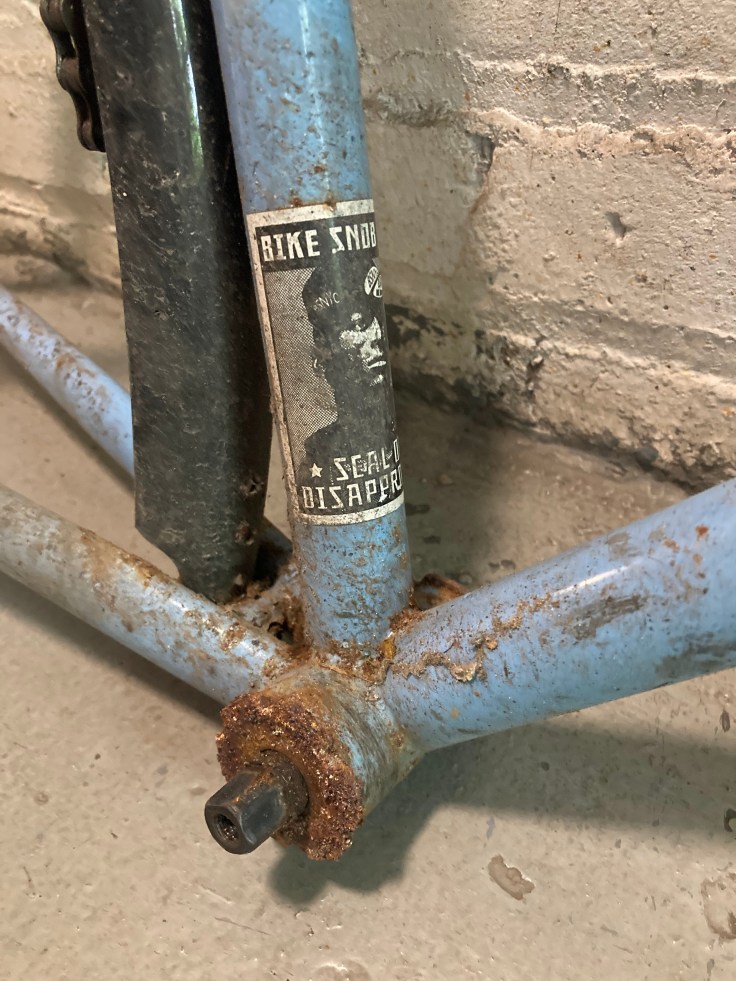
However, most of that scary-looking rust is on the bottom bracket cartridge, and I suspect that despite its gritty appearance this frame has a lot more miles in it. Also, it was the victim of what I would characterize as extreme neglect, and in addition to lots of general abuse (plus whatever use it saw from its previous owner or owners, for I was not the first), during a very snowy winter several years back I rode repeatedly in slush and road salt and then put it away for a prolonged period of time completely caked with both and then left it sitting for months. No bike treated with even a modicum of care would degenerate to this condition, but even so, at the time I disassembled it the bike was still rideable, and in a pinch I could make it rideable again pretty quickly. (It would probably take some doing to get that bottom bracket out, but the spindle still turns so most likely I’d just leave it in there.)
Stainless Steel
Back in 2011, Ritte, a company then known for its irreverence, built for me a prototype stainless steel road bike. I rode it until 2019, when I generously donated it to the Classic Cycle collection:

I realize stainless steel is, well, steel, but I’m giving it a separate category because it’s not regular steel, it’s pointless, gimmicky steel, and in my case anyway it didn’t come anywhere close to living up to its name:

Not too long after the Ritte arrived I moved to the Bronx and more or less stopped racing, and I think this bike only saw “competition” like once. However, after the move I was a lot closer to dirt, and I often rode this bike with 28mm tires on the Old Croton Aqueduct, so it saw plenty of use. The blemishes bothered me, and it also had a press-fit bottom bracket. I have no idea if the corrosion was a sign of deeper problems or it was just cosmetic, but during my time with the bike it held together just fine, and apart from the creeping crud my main complaint was how annoying it was to work on the press-fit bottom bracket.
By the way, Ritte still sells a stainless steel bike today. Ironically it’s called The Snob, and the tag line is “True love doesn’t rust:”

I’ll give them the benefit of the doubt and assume they sorted out that rust problem.
Titanium
When I was racing and grinding out miles on a Cannondale a titanium Litespeed or Merlin seemed like the very pinnacle of roadiedom, and thanks to Classic Cycle I finally got one like 20 years later:

This is the most modern road bike I have. I love riding it and I don’t have a single bad thing to say about it. It’s the bike that Ritte wishes it was.
The line on titanium is that it has a magical ride quality and it lasts forever. Well, nothing about the my own experience Litespeed gives any indication to the contrary: the ride is fantastic, and it still looks like it was made yesterday, not in 2001. Nevertheless I’m skeptical of the reputation titanium has for being practically unbreakable, for the simple reason that there are many, many reports of broken titanium bicycles. Of course, this post is supposed to be about my own experiences, not stuff people say on the Internet. Also, titanium is a niche material, owned mostly by the sorts of people who post stuff on Internet forums. So if anything happens to a titanium bike, you’re definitely going to hear about it.
As for my sample size of one, there are no problems here…though as one of many bikes owned by an aging blogger it’s not seeing the sort of mileage and intensity my old race bikes did.
Wood
In like 2017 a company called Renovo sent me their Aerowood road bike. It was indeed made of wood, it had carbon wheels and Di2 shifting, and the retail price was about $10,000:

Not too long afterwards, Renovo went bankrupt, probably because who the hell is going to pay $10,000 for a road bike made of wood?
I really enjoyed riding the Renovo, partly because it’s a bike I’d never, ever have chosen for myself, and partly because it did feel really good. In fact, I even raced it numerous times during my short-lived comeback. Eventually, though, the Renovo began to creak like a pirate ship, and close inspection of the bolts around the dropout area revealed little splits or cracks in the wood. My recollection is that the Renovo guy said it was safe to ride, it was just a small cosmetic problem they’ve since remedied, and so forth and so on, all of which was probably true (are you afraid of falling through your creaky wood floor?), but all of which also confirmed everything you’d suspect might happen with a bike made of wood. It was a beautiful bike that turned heads wherever it went, but it was also completely and utterly ridiculous, and it too is now a part of the Classic Cycle collection:

As for the company, someone ended buying Renovo and it still appears to exist, and a brief Internet search indicates there are various other people making high-end wooden bicycles too, though Lob knows who’s actually buying them.
Conclusions
OK, so to review:
- I’ve never had a steel bike fail, though I have had one get pretty rusty (the Ironic Orange Julius Bike). I’ve also gotten years of hard use out of already well-used steel frames I bought very cheaply, indiscriminately used rear wheels from 120mm to 130mm in an old steel road frame without issue, etc.
- I’ve never had a titanium bike fail or succumb to any aesthetic blemishes, though my sample size of one is so tiny as to be meaningless, and it leads a pampered life
- I have had an aluminum bike fail, though that was a “superlight” frame, and I’m sure if I’d had a steel bike that had been built too light for marketing purposes that would have failed too
- I got close to a decade of good use out of a carbon road bike, though by the end of that time I’d almost certainly reached the end of its useful life
- My carbo-luminum bike started coming apart, my stainless steel bike stained, and my wood bike got creaky, all of which suggests to me there’s absolutely nothing to be gained by deviating from materials like steel, aluminum, carbon, or titanium, or by mixing them together.
Therefore, I conclude, based on my own experience:
- Steel is extremely reliable and a great value, just wipe it down once in awhile if you ride on salty roads. Otherwise it performs well for all types of riding, it can be had dirt cheap, and you can totally experiment with it and treat it like crap.
- Aluminum is reliable and a great value, it can also be had dirt cheap, just avoid the superlights (probably true for any material). I also wouldn’t go messing with the rear spacing or anything like that, though admittedly that’s based on what I read, not from personal experience. And while steel can rust, aluminum can also bubble under the paint and do other weird things–especially if you’re a heavy sweater like me, trust me.
- Clearly you can get lots of good use out of a carbon bike, but I got nothing out of mine that I didn’t get out of my steel and aluminum bikes, which are generally much cheaper. Like drugs in college, if you’re a racer of course you’re going to try carbon at some point, but like drugs in adulthood I don’t really see the point. However, it’s also worth noting that I’ve had carbon forks on lots of different bikes, and [knock on wood] I’ve never had a problem there, the video above notwithstanding. Seems to me if you want light weight and bang for your buck in a pure race bike you get an aluminum bike with a carbon fork, and if you want bang for your bike for riding of all types you get a steel bike and that’s that. There are all sorts of engineering arguments for and against carbon, but ultimately it just strike me as not a very good value. But that’s just me.
- I love my titanium bike. But like carbon it just seems like a bad value compared to steel and aluminum. (Unless you’re the Classic Cycle Old Crap Test Pilot and have the opportunity to trade a creaky wooden bike for a pristine titanium one.) If it’s really as durable as they say then it is a better value than carbon, but people say a lot of things, don’t they? Also, I still want a titanium Jones with carbon parts. Because bikes are a disease.
- No reason to mess around with weirdo materials or strange combinations thereof, for the reasons above. (Oh, I just remembered I also had a magnesium bike for awhile, but not long enough to draw any conclusions about longevity.)
Winner
For me, it’s gonna be steel. Unless rust really freaks you out I don’t see the downside. But you do what you want.